
An old name
The English papadam and Kerala’s pappadam are connected to Tamil pappatam and likely to the Sanskrit parpata, a word for a thin or flattened disc. References in early Jain and Buddhist literature show that the idea, and its name, have deep South Asian roots. They do not, however, give us a neat date for the Kerala recipe we eat today.
Many regions, many rounds
Papad is not one fixed recipe. Across the subcontinent it may be made from black gram, other lentils, chickpea, rice, tapioca, millet, potato, or sago. It may be fried, roasted over flame, or cooked with dry heat. Kerala’s familiar version is typically a pale black-gram wafer that blooms dramatically in hot oil.
A household craft
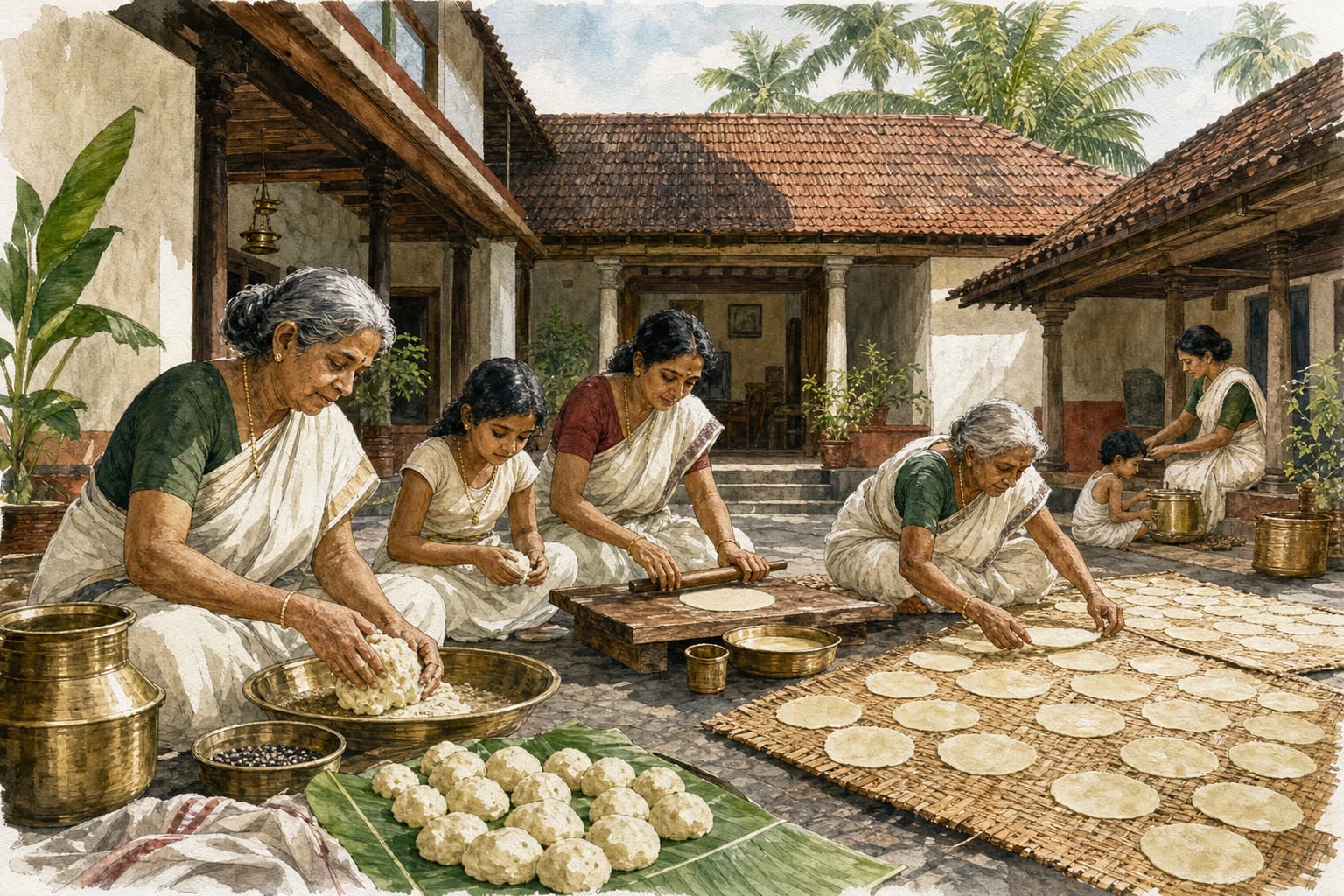
Before packaged pappadam became common, makers in Kerala’s towns and villages prepared and sold it locally. Dough was worked, divided, rolled wafer-thin, and dried. Accounts of makers selling pappadam in kettu, or bundles, to neighbouring households and small shops preserve a glimpse of this local economy.
A place on the leaf
In Kerala, pappadam found its most ceremonial setting in sadya: the vegetarian feast served on a banana leaf for Onam and other occasions. It also belongs to ordinary days, beside rice and curry or crushed into kanji. Its importance comes from repetition at family tables, not only from festival spectacle.
Tradition keeps changing
Kerala also has rice, tapioca and other regional pappadam traditions. Production moved from courtyards and specialist households toward mechanised rolling, controlled drying, and sealed packs. The method changed scale, while the essential pleasure remained the same: a thin disc becoming blistered, airy and crisp in seconds.